Repeatable Circuits From the Sea: Why Stamps, Seaweed and Gel Polish Could Change How We Make Electronics
Most homemade circuit boards still begin with copper, acid and a sink you will never fully trust again.
That process works. It also assumes the board has to look like the inside of a laptop.
It doesn’t.
A carved stamp can lay the same conductive-ink traces on sheet after sheet. Seaweed paper or alginate film can be the insulator. Gel nail polish can sit in between those layers as a UV-cured dielectric — the thing that keeps one stamped network from shorting the next, and the clear coat that keeps humidity out of a material that used to live in the ocean.
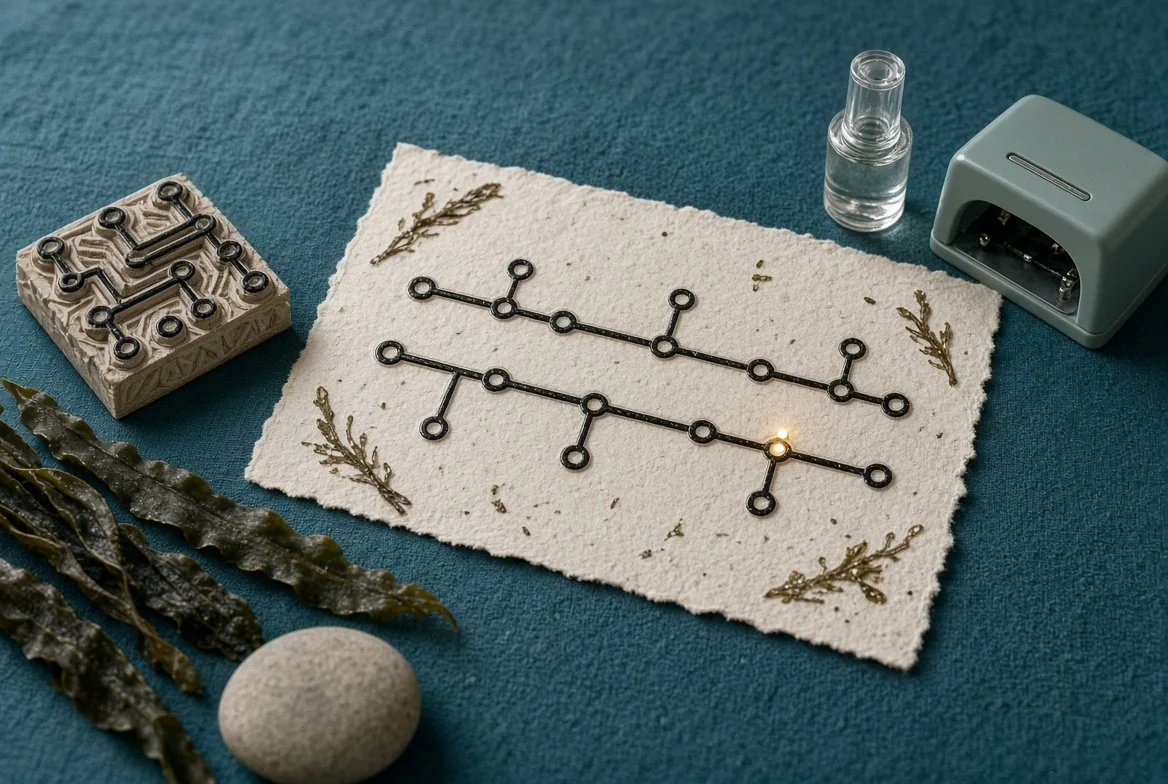
The product isn’t a replacement motherboard. It’s a repeatable, low-voltage circuit you can make without a fab house.
That combination sits at an interesting intersection: printmaking, ocean materials, paper electronics and a bottle already sitting on millions of bathroom counters.
The Problem With One-Off Circuits
Hand-painted conductive ink works. People have been lighting LEDs on paper for years.
The limitation is repetition.
A brush makes a circuit. A stamp makes a run.
Once the raised traces on a linoleum block, a rubber plate or a 3D-printed relief are right, the same layout can be pressed onto the next sheet with the same spacing, the same pad locations and the same gaps. That is the difference between a workshop demo and a small series of working boards.
For first projects, that matters more than density. Traces should stay wide — two to four millimeters — because carbon ink behaves like a resistor. Short paths win. Fine-pitch chips and motors do not belong here. Coin cells, LEDs, paper switches and simple sensors do.
Seaweed Is Not a Gimmick. It’s the Board.
Seaweed paper and sodium alginate film are insulating substrates. They take water-based carbon inks. They compost more readily than epoxy. They also drink moisture.
That last point is why the stack needs a layer in between the ink and the room.
Alginate — the gelling polymer extracted from brown seaweed — already shows up in research as a binder in carbon and silver inks. The same family of material can be cast into a thin film, stamped, and sealed. The board and the binder can come from the same ocean chemistry.
Buy food-grade kelp, nori scraps or alginate powder. Do not harvest marina seaweed and put it in a blender.
The Stamp Makes the Circuit Repeatable
Draw the layout mirrored. What stands up on the block is what prints.
If the board needs two layers, carve two plates.
Stamp A carries power and ground.
Stamp B carries signal traces and pads, offset so connections land only where you leave a window in the gel.
Test the stamp with ordinary ink on scrap paper first. A broken line on the test print is a dead trace on seaweed.
Then tape the seaweed sheet flat, load the stamp with a thin film of conductive ink, press straight down and lift straight up. Dry fully. Carbon paint can feel dry in minutes and still measure poorly until it finishes.
Check continuity pad to pad. Repair gaps with a toothpick of ink. Scrape bridges after the film skins.
That first impression is the repeatable circuit. Every later sheet should match it if ink load and pressure stay the same.
Gel Nail Polish Is the Layer In Between
Industrial flex circuits and membrane switches already use UV-curable dielectric inks between printed conductors. The job of that layer is simple: isolate one network from another, then resist humidity.
Clear, non-metallic gel nail polish is not a lab coating. It is a kitchen stand-in for the same idea.
Hobbyists have used ordinary nail polish for years as a conformal coat on small boards. Once fully cured, it measures as a high-resistance insulator. UV gel improves on air-dry polish because it skins in under a minute, builds thickness in thin coats, and can be applied only where isolation is needed.
“In between” means three jobs.
It covers a stamped trace so a second trace can cross without shorting.
It separates layer one from layer two so a second stamp can print on top of the first.
It seals the finished seaweed sheet against damp air.
Use clear base coat and a no-wipe top coat. Avoid glitter, chrome, magnetic and metallic polishes. Particles in those formulas can bridge traces.
Mask the pads you still need. Brush a thin coat — not a puddle. Cure 30 to 60 seconds under an LED lamp. Add a second coat if pinholes remain. If the surface stays sticky, that is the oxygen inhibition layer. Wipe it with isopropyl alcohol or cap it with a no-wipe top coat and cure again.
Then test isolation. Neighboring traces that should not touch should read open circuit. If they still conduct through the gel, the coat is too thin. Add another cured layer.
Do not coat battery contacts.
Then Stamp the Second Circuit on the Gel
The cured gel is now the new printing surface.
Ink the second stamp. Align it to the windows left in the gel. Press and lift.
Where a via should connect down, add a small puddle of conductive ink in the window so layer two ties to layer one.
Finish with one more thin gel coat over everything except the contacts. That last coat is the moisture barrier seaweed paper does not have on its own.
Mount LEDs and resistors in wet ink on the open pads, or use copper tape. Power the board with a coin cell first.
Then print the same pair of plates on a second sheet.
Same stamp. Same ink load. Same gel thickness. A second working board.
That is the test. If it lights, the method is repeatable.
Why This Stack Is Interesting
Tape leaves edges that ink can crawl under.
Air-dry varnish stays soft on damp alginate.
A paintbrush cannot guarantee the next circuit will match the last one.
A stamp can.
Seaweed gives the board a material story that is actually doing work: insulation, compostability, and a surface that accepts water-based ink.
Gel polish gives the stack a dielectric that is already manufactured at consumer scale, already UV-cured, already designed to form a thin, clear film.
None of that makes this a product you should ship into a rainstorm. Gel polish can yellow. It can peel off dusty paper. It is not rated conformal coating. Uncured gel can sensitize skin. Cure it fully, in a ventilated space, and treat this as electronics — not a manicure.
Silver ink and coin cells do not belong in the compost. The seaweed sheet can, once the parts come off.
The Bigger Opportunity
The old wish in home fabrication was to print the copper.
This is a sideways answer.
Print the circuit with a stamp.
Print it on a sheet that used to be kelp.
Isolate the copies with a UV film people already know how to cure.
The opportunity is not another etched board.
The opportunity is a small, repeatable electronics practice that starts in the ocean and finishes under a nail lamp.
Every additional sheet is a chance to ask a better question than “can I paint one LED circuit?”
The better question is:
Can I print the same one five times — and keep the layers from becoming one short?