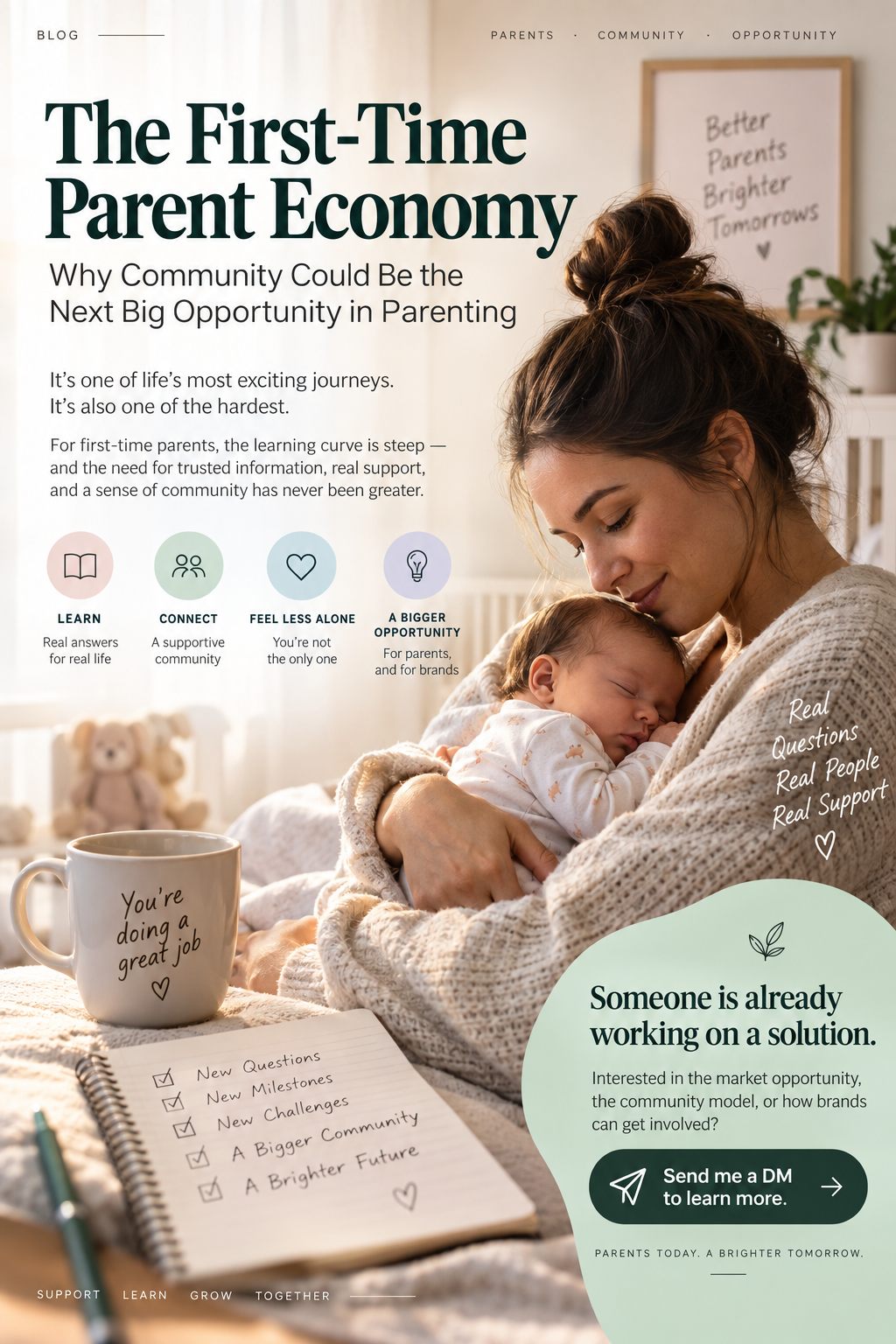
The First-Time Parent Economy: Why Community Could Be the Next Big Opportunity in Parenting
Becoming a parent may be one of the most anticipated moments in someone’s life. It can also be one of the most overwhelming.
For first-time parents, nearly everything is new.
How much should a newborn sleep? Is the baby eating enough? Is this rash normal? When should they start sleeping through the night? What should a mother expect while recovering from childbirth? Which products are actually necessary? When should parents call a pediatrician? And perhaps one of the most common questions of all:
“Is what I’m experiencing normal?”
There are books, pediatricians, apps, websites, social media accounts and thousands of Google results ready to provide answers. Yet information isn’t necessarily the same thing as support.
What many new parents—particularly new mothers—are looking for is something much more human:
A trusted community where they can learn, ask questions, compare experiences and realize they aren’t navigating parenthood alone.
That creates an interesting opportunity at the intersection of parenting, education, community and commerce.
Parenthood Comes With an Enormous Learning Curve
There were approximately 3.6 million births in the United States in 2025 alone, according to provisional data from the CDC. (CDC)
That means millions of families enter or re-enter the newborn stage every year.
For first-time parents, the transformation is particularly significant. Overnight, adults who may be highly competent in their careers and personal lives suddenly become beginners in an enormously consequential new job.
And babies don’t arrive with instruction manuals.
Research into online parenting communities demonstrates just how actively mothers seek information and reassurance. Studies of postpartum parenting forums have found that conversations frequently revolve around feeding, breastfeeding, sleep, infant health and development. Researchers have also observed mothers repeatedly using these communities for help, reassurance and emotional support. (PubMed Central (PMC))
This is important because it demonstrates that parents aren’t simply searching for information.
They are searching for context.
There is a significant difference between searching:
“How many hours should a three-month-old sleep?”
and asking:
“My three-month-old suddenly stopped sleeping the way she did last week. Has anyone else experienced this?”
The first question can be answered by a search engine.
The second benefits from community.
New Mothers Want Information—and Connection
Digital resources have become deeply embedded in pregnancy and early motherhood.
Research examining how women use digital media during pregnancy and early motherhood found that they valued information that was immediate, regular, detailed, customized, practical, professional, reassuring and unbiased. The same research found that women valued digital technology for maintaining connections with other mothers while also wanting access to professional expertise. (PubMed Central (PMC))
That combination may be particularly powerful:
Expert knowledge + lived experience + community.
Research specifically involving first-time mothers has similarly found that online communities can provide empathy, encouragement, information and socialization. (PubMed)
That’s a fundamentally different product from another library of parenting articles.
Imagine a platform where expecting and new mothers could join communities based on their stage of pregnancy or their baby’s age.
A woman who is 30 weeks pregnant could connect with other women approaching delivery.
A mother with a two-week-old newborn could speak with other mothers awake during those same 2 a.m. feedings.
A parent wondering about breastfeeding, sleep, returning to work, postpartum recovery or developmental milestones could learn from vetted experts while also hearing from parents experiencing the same thing.
The product isn’t simply information.
The product is belonging, reassurance and trusted access to knowledge.
The Need for Support Is Real
The postpartum period isn’t simply difficult because parents are tired.
It can be an extraordinarily significant physical, psychological and social transition.
Research on first-time mothers has concluded that social support is important to postpartum well-being. (PubMed) Other research examining perinatal depression and loneliness found recurring themes involving emotional disconnection, insufficient support and isolation, while peer support and understanding from other mothers were among the factors that could help alleviate loneliness. (PubMed Central (PMC))
That doesn’t mean an online parenting community should replace medical care, mental-health treatment or professional support.
It means there is an important layer between the doctor’s appointment and being alone at home.
That’s where community can become incredibly valuable.
The Market Opportunity Is Bigger Than an App Subscription
The most interesting part of the parenting market may be that the consumer doesn’t necessarily need to carry the entire cost of the platform.
Parents represent an unusually valuable audience because the arrival of a child triggers purchasing decisions across dozens of categories.
Think about what happens before and after a first baby arrives:
Strollers. Car seats. Cribs. Diapers. Formula. Bottles. Breast pumps. Clothing. Toys. Baby monitors. Furniture. Insurance. Healthcare. Childcare. Travel products. Food. Cleaning products. Financial planning. Education savings. Family vehicles. Home products.
The transition into parenthood can reshape household purchasing behavior for years.
That means a trusted parenting community doesn’t just have a B2C opportunity.
It potentially has a substantial B2B2C opportunity.
Understanding the Total Addressable Market
A simple way to begin estimating the U.S. TAM is with annual births.
The CDC reported approximately 3.63 million births in 2024, followed by a provisional 3.61 million births in 2025. (CDC)
But annual births substantially understate the addressable audience.
A parenting platform doesn’t necessarily serve a family for only one year.
If the relevant customer lifecycle extends from pregnancy through a child’s fifth birthday, each annual birth cohort creates another layer of potential users.
Using roughly 3.6 million births annually as a simplified benchmark, five birth cohorts alone represent approximately:
18 million child-years of newly formed family relationships.
And that’s before including partners, caregivers, grandparents, parents with multiple children or families continuing to use the platform as children age.
The TAM therefore shouldn’t simply be described as “3.6 million new babies.”
It can be thought of as a continuously replenishing audience of millions of households navigating one of life’s highest-information and highest-purchasing-intent periods.
The Advertising Opportunity
The broader digital advertising ecosystem provides important context for why this model could work.
According to the IAB/PwC Internet Advertising Revenue Report, U.S. digital advertising revenue approached $300 billion in 2025, increasing 13.9% year over year. (IAB)
Parenting platforms can offer advertisers something particularly attractive: context and intent.
Someone participating in a newborn sleep community isn’t simply a generic consumer.
They may be actively researching products and services related to newborn sleep.
Someone entering a “returning to work” community could be evaluating childcare, breast pumps, meal services, workwear, insurance and household services.
Someone preparing for birth may soon purchase a car seat, stroller, crib, monitor and dozens of other products.
This creates opportunities for companies to reach parents when their products are genuinely relevant—provided advertising is transparent and separated from independent medical or educational guidance.
Companies Already Have Budgets for Reaching Parents
A parenting community doesn’t have to invent a new corporate expense category.
Companies already spend money trying to reach these consumers.
Those dollars live across:
digital advertising, social media, influencer marketing, creator partnerships, sampling, affiliate marketing, sponsorships, content marketing, customer acquisition, healthcare education and brand partnerships.
A parenting platform can potentially consolidate several of those opportunities.
Instead of simply purchasing impressions, a baby brand might sponsor an educational series.
A stroller company might provide products for community testing.
A diaper company might sponsor newborn welcome kits.
A financial-services company could sponsor educational content about starting a college fund.
A healthcare organization could support professionally reviewed educational resources.
A baby-food company could participate in an age-appropriate nutrition program, with appropriate disclosures and safeguards.
The difference is important.
The platform doesn’t have to sell parents to advertisers. It can give appropriate brands an opportunity to fund useful experiences for parents.
That distinction can become part of the business model.
What the Business Model Could Look Like
A strong parenting community could ultimately have multiple revenue streams:
Brand partnerships and sponsorships could provide the largest source of revenue while keeping the core community accessible.
Affiliate commerce could allow parents to purchase products recommended through clearly disclosed shopping resources.
Premium memberships could provide optional access to classes, experts, events or specialized groups.
Employer benefits could allow companies to offer parenting education and community access as an employee benefit.
Healthcare partnerships could connect families with evidence-based resources while maintaining strict boundaries around medical advice.
Research and insights could potentially provide companies with aggregated, privacy-protected understanding of what parents need—subject to strong consent, privacy and ethical safeguards.
This creates an important strategic advantage.
The company doesn’t necessarily need to ask an exhausted new mother to pay $30 every month for another subscription.
The economic value of the community can be distributed across the ecosystem surrounding the parent.
Community Is the Moat
Information is becoming increasingly commoditized.
Search engines can answer questions.
AI can explain developmental milestones.
Apps can send reminders.
But technology has a much harder time replacing the feeling of hearing:
“My baby did that too.”
Or:
“I struggled with that for three weeks. Here’s what helped us.”
Or simply:
“You’re not the only person awake right now.”
That emotional layer matters.
And it can also create a powerful business moat.
A parenting app can be copied.
A database can be copied.
Features can be copied.
A trusted community containing thousands or millions of meaningful relationships is much harder to replicate.
From 300 Mothers to a Much Bigger Vision
I’ve seen a small version of this opportunity firsthand.
Years ago, I built a pregnancy education app that ultimately reached and supported more than 300 mothers. What became interesting wasn’t simply the educational material. It was seeing how much women wanted to learn during pregnancy and how valuable it was to make complicated information easier to understand.
The technology available today makes it possible to imagine something dramatically larger.
Instead of only delivering pregnancy information, a modern platform could combine personalized education, expert content, AI-assisted discovery and—most importantly—human community.
The opportunity isn’t to build another website telling mothers what to do.
It’s to build a place where parents can learn together.
The Bigger Opportunity
Every year, another approximately 3.6 million babies are born in America. (CDC)
Behind those babies are millions of questions.
Millions of late-night searches.
Millions of product decisions.
Millions of moments when someone wonders whether they’re doing this correctly.
And millions of parents who could benefit from hearing from someone going through exactly the same thing.
That is what makes this market particularly interesting.
The commercial opportunity is significant because brands already spend enormous amounts of money competing for parents’ attention.
But the human opportunity may be even bigger.
Build trust first. Build community second. Let commerce support the community—not control it.
Because first-time parents don’t need another company shouting at them.
They need a place that helps them feel informed, supported and connected while they’re learning how to do one of the hardest—and most meaningful—jobs in the world.