Rewiring the Mind: How Smart Helmets Use Light and Sound to Treat Stress, Depression, and Addiction
The helmet on your desk looks like something out of a near-future sci-fi film—sleek, minimal, fitted with subtle, pulsing light rings. But it isn't designed to protect your head from a crash. It is designed to heal what’s happening inside it.
We are standing at the threshold of a revolution in neurotechnology. For decades, treating depression, addiction, and chronic stress meant choosing between pharmaceutical intervention or long-term behavioral therapy. Today, non-invasive bio-energetic technologies are converging into a single wear-and-forget device: the multi-modal smart helmet.
Here is how four distinct physical modalities—ultrasound, radio frequencies, sound waves, and light—work in unison inside one piece of headwear to re-wire, calm, and restore the human brain.
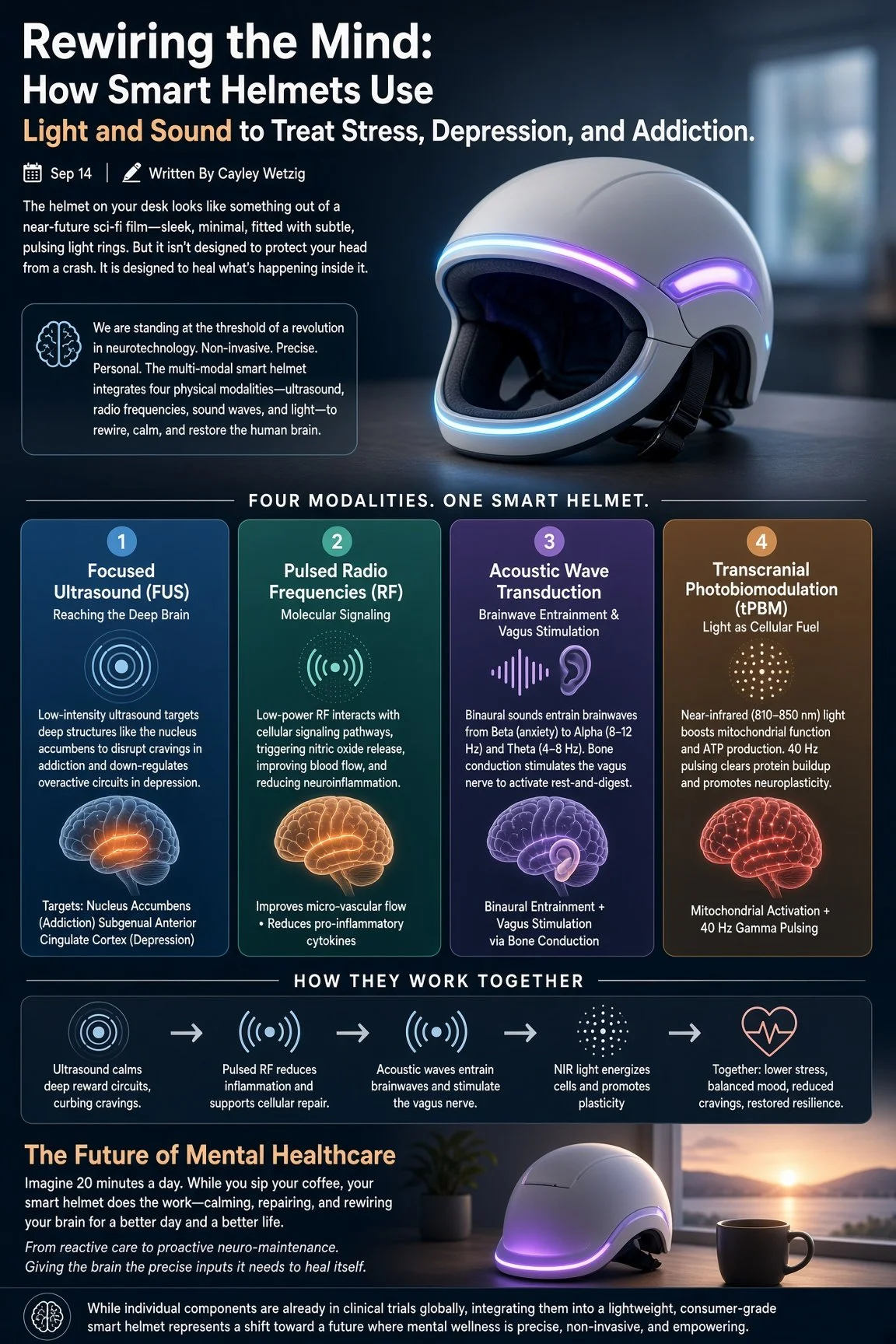
1. Focused Ultrasound (FUS): Reaching the Deep Brain
Traditional non-invasive treatments struggle to target deep brain structures without affecting the cortex above them. Ultrasound changes that completely.
Targeting Addiction: Low-intensity focused ultrasound can target deep-brain regions like the nucleus accumbens—the core of the brain’s reward circuit. By gently modulating neural activity in this area, ultrasound can disrupt the compulsive "cravings loop" without invasive surgery.
Targeting Depression: Ultrasound waves can be steered to target the subgenual anterior cingulate cortex, an area frequently hyperactive in treatment-resistant depression, helping to down-regulate overactive emotional circuits.
2. Pulsed Radio Frequencies (RF): Molecular Signaling
Low-power, non-thermal radio frequencies interact directly with cellular signaling pathways rather than neural firing patterns.
Cellular Repair: RF pulses interact with voltage-gated calcium channels in brain cells, triggering the release of nitric oxide. This improves micro-vascular blood flow throughout the cortex.
Reducing Neuroinflammation: Chronic stress and depression are deeply linked to neuroinflammation. Pulsed RF fields help down-regulate pro-inflammatory cytokines, creating a cleaner chemical environment for neurotransmitters to function properly.
3. Acoustic Wave Transduction: Brainwave Entrainment & Vagus Stimulation
Sound acts as both a macro-pacing tool and a physical vibration mechanism within the helmet’s frame.
Binaural Auditory Entrainment: By delivering slightly different sound frequencies to each ear, the helmet induces brainwave synchronization. It drives dominant brainwaves down from high-anxiety Beta states into calm Alpha (8–12 Hz) or deeply restorative Theta (4–8 Hz) states.
Bone Conduction to the Vagus Nerve: Bone-conduction transducers built into the helmet’s rim send soft acoustic vibrations through the temporal and occipital bones, stimulating branches of the vagus nerve to instantly engage the parasympathetic "rest-and-digest" response.
4. Transcranial Photobiomodulation (tPBM): Light as Cellular Fuel
Embedded near-infrared (NIR) LEDs (typically in the 810–850 nm spectrum) penetrate the skull to deliver light energy directly to cortical tissue.
Mitochondrial Activation: Near-infrared light is absorbed by cytochrome c oxidase, an enzyme inside cell mitochondria. This boosts ATP (cellular energy) production in sluggish brain regions.
Gamma Wave Pulsing (40 Hz): Flashing light at specific frequencies like 40 Hz has been shown to clear protein buildup and promote neuroplasticity, helping the brain unlearn rigid stress patterns and form healthier neural pathways.
How the Modalities Work Together:
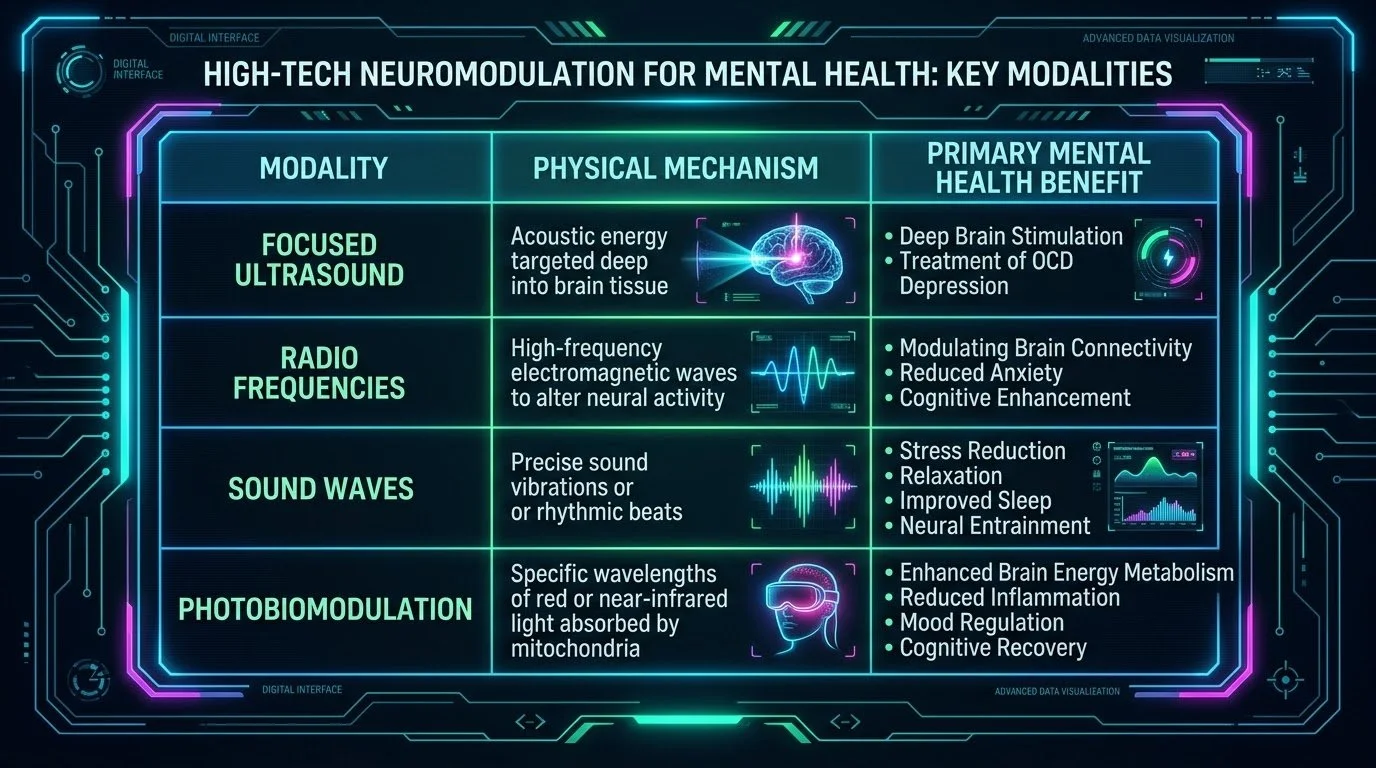
The Future of Mental Healthcare
Imagine putting on a helmet for 20 minutes every morning. While you drink your coffee, ultrasound gently calms your brain's reward center to curb nicotine or substance cravings, near-infrared light energizes depleted cortical cells, pulsed RF calms systemic brain inflammation, and soothing acoustic vibrations lower your heart rate.
While individual components of this technology are already in clinical trials globally, integrating them into a lightweight, consumer-grade smart helmet represents a shift from reactive mental healthcare to proactive neuro-maintenance.
The future of mental wellness isn't just about managing symptoms—it's about giving the brain the precise physical inputs it needs to heal itself.