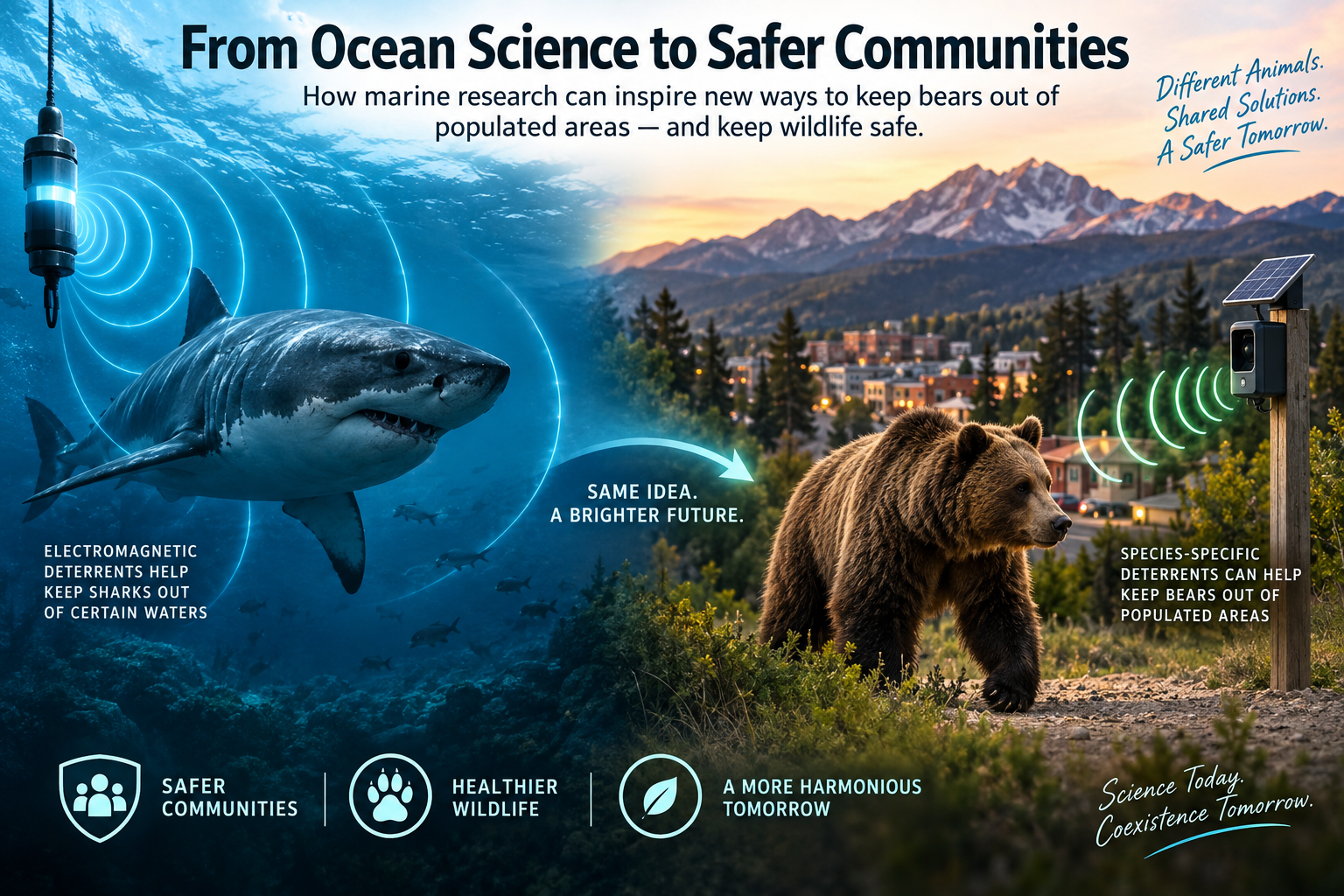
What if technology designed to keep sharks away from certain areas of the ocean could inspire a new way to keep bears away from heavily populated communities?
It sounds futuristic, but the underlying concept is already being explored in wildlife conservation: instead of waiting for animals and humans to come into conflict, could technology create invisible or minimally invasive boundaries that encourage wildlife to turn around before an encounter occurs?
Marine researchers have already investigated versions of this concept with sharks. While the technology is sometimes casually described as using “radio frequencies,” the science is more precise: researchers have studied electric and electromagnetic fields because sharks have an extraordinary ability to detect them.
Bears have very different sensory biology, so the exact same technology cannot simply be transferred from the ocean to the mountains. But the principle behind it could inspire an entirely new generation of non-lethal bear deterrent technology.
How Do Electromagnetic Shark Deterrents Work?
Sharks have a sensory ability humans don’t possess.
Sharks and rays have specialized electroreceptors known as the ampullae of Lorenzini, which allow them to detect extremely weak electric fields in their surroundings. This extraordinary biological system helps sharks detect prey and interpret their environment.
Scientists have investigated whether artificially generated electric or electromagnetic fields can therefore alter shark behavior.
Research on electric shark deterrents has found promising results under certain experimental conditions. One field study involving white sharks found that an electric deterrent significantly affected how closely sharks approached a source.
Researchers have also investigated magnets and other electromagnetic approaches for reducing shark interactions with fishing equipment.
The important concept isn’t that scientists have discovered a universal “shark-repelling frequency.” They haven’t.
Instead, researchers are exploiting a species-specific sensory system to encourage an animal to make a different behavioral decision.
Essentially, the technology is attempting to tell the shark:
This isn’t somewhere you want to go.
And that concept could have fascinating implications for wildlife management on land.
Could Shark Science Inspire Bear Deterrent Technology?
Bears don’t have the same electroreceptive organs as sharks.
So broadcasting the electromagnetic signals used in shark deterrents should not be assumed to repel bears.
But what if researchers approached bears using the same scientific philosophy?
Instead of asking:
“How do we remove a bear after it enters a neighborhood?”
We could increasingly ask:
“How can we safely encourage the bear not to enter the neighborhood in the first place?”
That distinction could be transformative for communities where humans and bears increasingly occupy overlapping spaces.
Imagine a Smart Wildlife Boundary
Consider a mountain community bordering black bear habitat.
Rather than constructing enormous physical barriers, a future wildlife-management system could potentially combine several technologies.
Thermal cameras and computer-vision systems could identify animals approaching town. Artificial intelligence could distinguish a bear from a dog, deer, cyclist or hiker.
Once a bear was confidently detected, the system could activate a species-appropriate, scientifically validated, non-lethal deterrent.
The goal wouldn’t be to hurt the bear.
It would simply encourage the animal to choose another direction.
A future system might combine AI-powered wildlife detection, thermal imaging, smart cameras, strategically placed electric fencing, bear-resistant waste infrastructure, wildlife corridors and carefully researched sensory deterrents.
Over time, anonymized environmental data could also help wildlife managers understand where and when bears are entering populated areas.
Instead of reacting to wildlife conflict, communities could begin predicting and preventing it.
We Already Use Non-Lethal Technology to Keep Bears Away
This concept isn’t entirely hypothetical.
Electric fencing is already used to protect garbage, livestock, beehives, gardens and other attractants from bears.
Wildlife researchers have also investigated motion-activated deterrent systems and aversive conditioning.
A 2024 study examining motion-activated deterrent devices around Montana farms found that activated devices reduced the odds of grizzly bears accessing attractants. The research demonstrates something important: technology can sometimes influence bear behavior without requiring the animal to be removed or killed.
But research also highlights the limitations of deterrents.
Bears are intelligent and adaptable. Some can become habituated to repeated stimuli, particularly when a powerful food reward is available.
That’s why the most promising future isn’t likely to be one magical sound, frequency or device.
It is a layered wildlife-management system.
AI Could Make Bear Deterrents Smarter
Artificial intelligence could make this approach significantly more sophisticated.
Imagine cameras positioned along known wildlife corridors surrounding a mountain town.
Instead of activating every time something moves, an AI model could identify the species approaching the boundary.
Bear detected.
The system could then activate a deterrent designed specifically for bears while simultaneously alerting wildlife managers.
If a deer walks past, nothing happens.
If a person approaches, nothing happens.
If a bear approaches, the system responds.
Computer vision could potentially make wildlife deterrents more targeted, reducing unnecessary disturbances to animals and humans.
Could Wildlife Systems Learn Over Time?
The most interesting possibility may be the data.
A smart wildlife network could potentially record patterns such as:
where bears most frequently approach populated areas
what time of day encounters occur
seasonal changes in bear activity
environmental conditions associated with increased movement
nearby food or garbage attractants
which deterrent interventions successfully cause bears to change direction
Machine-learning systems could eventually identify patterns humans might otherwise miss.
For example, wildlife managers might discover that a particular corridor experiences dramatically increased bear activity during certain weather conditions or when natural food availability declines.
Communities could then intervene before conflicts increase.
Why Keeping Bears Out of Town Also Protects Bears
When people hear “bear deterrent,” the immediate assumption is often that the technology exists primarily to protect humans.
But keeping bears away from populated areas can also protect the bears themselves.
Bears that repeatedly obtain food from garbage, restaurants, dumpsters, bird feeders or other human sources can begin associating populated areas with easy calories.
Once that behavior becomes established, encounters with humans can become more frequent and more dangerous.
In severe cases, wildlife officials may eventually have to relocate or euthanize an animal.
Preventing that behavioral pattern from developing in the first place could therefore be one of the most humane approaches to human-bear coexistence.
Aspen Shows Why Human-Bear Coexistence Matters
Mountain communities such as Aspen, Colorado, provide an interesting environment for thinking about these technologies.
Homes, restaurants, hotels, hiking trails and businesses exist extremely close to black bear habitat.
Researchers have previously studied how natural food availability affects black bears’ use of Aspen’s urban environment, illustrating how changes in the natural ecosystem can influence whether bears move into town searching for food.
This creates an unusual conservation challenge.
We don’t necessarily want bears to disappear from these ecosystems.
Seeing wildlife is part of what makes mountain communities extraordinary.
The challenge is finding ways for humans and wildlife to occupy the same broader landscape without encouraging dangerous proximity.
From Shark Deterrents to Bear Conservation
The connection between sharks and bears isn’t about putting underwater shark equipment in the Colorado mountains.
It’s about borrowing an innovative scientific approach.
Marine researchers asked:
What sensory systems make sharks unique, and can we use that knowledge to reduce unwanted interactions without removing the shark?
Wildlife researchers can continue asking the same question about bears.
What sensory cues matter most to them?
How quickly do they habituate to different deterrents?
Can technology distinguish individual behavioral patterns?
Can deterrents be activated only when necessary?
Can AI predict when human-bear conflicts are most likely?
And can communities create intelligent boundaries that redirect wildlife rather than simply reacting after something goes wrong?
The Future of Conservation Could Be Invisible
For decades, humans have frequently responded to wildlife conflicts with physical barriers, relocation or lethal control.
Technology gives us another possibility.
The next generation of wildlife conservation could involve AI wildlife detection, predictive analytics, smart fencing, thermal cameras, intelligent sensors and species-specific non-lethal deterrents working together.
The shark research offers an important lesson: animals experience their environments through sensory systems very different from ours.
Understanding those systems may allow us to communicate a surprisingly simple message without harming the animal:
This direction isn’t safe. Choose another path.
For sharks, researchers are exploring electric and electromagnetic signals.
For bears, the solution will almost certainly be different.
But the goal can be the same.
Keep wildlife wild. Keep people safe. And use technology to make coexistence possible.