Every day, millions of disposable diapers are thrown away. Their convenience has transformed parenting, but that convenience comes with an environmental cost: conventional disposable diapers contain multiple plastic-based components and can persist in landfills for generations.
What if some of that fossil-fuel-derived plastic could eventually be replaced by a material grown using sunlight, water, carbon dioxide, and nutrients?
Algae may offer part of the solution.
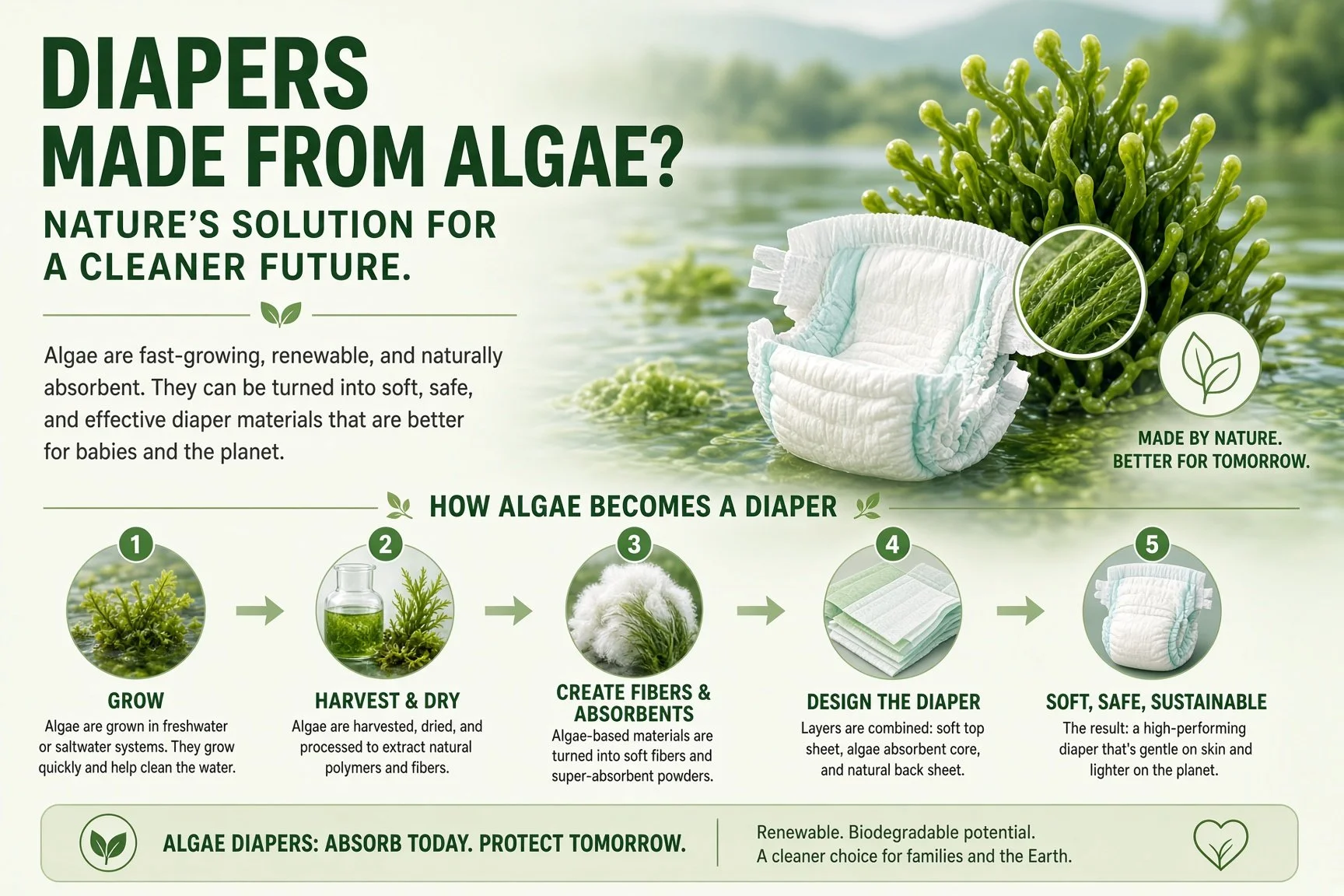
Researchers and material-science companies are exploring algae and microalgae as feedstocks for bioplastics, foams, films, fibers, coatings, and other biomaterials. While a commercially scalable diaper made entirely from algae is not yet the norm, advances in algae-based materials raise an exciting possibility: replacing certain petroleum-derived components of disposable diapers with renewable, potentially lower-impact alternatives.
The Plastic Problem in Disposable Diapers
A modern disposable diaper isn't simply cotton and absorbent material. It typically combines several engineered layers, including a soft topsheet, absorbent core, waterproof backsheet, elastic components, adhesives, and fastening systems.
Many of these components incorporate petroleum-derived polymers.
That matters because disposable diapers are designed to perform for several hours but may remain in the environment far longer after they are discarded.
Diapers also present a particularly difficult waste problem because they combine plastics, fibers, superabsorbent polymers, adhesives, and human waste. That mixture makes conventional recycling extremely challenging.
Globally, plastic waste is a major contributor to the waste stream, but it is important to distinguish this from saying plastic is the number-one cause of all landfill waste. Landfills contain many categories of material, including food, paper, construction debris, textiles, plastics, and other waste. The stronger environmental argument is that plastics are particularly concerning because of their enormous production volumes, dependence on fossil resources, persistence, and relatively low global recycling rates.
Why Algae?
Algae are extraordinarily interesting organisms from a sustainability perspective.
Unlike petroleum, algae are a renewable biological resource. Many species grow rapidly, and algae can be cultivated in ponds, photobioreactors, saltwater, wastewater, or other systems depending on the species and application.
During photosynthesis, algae also use carbon dioxide as they grow.
This creates opportunities to turn harvested algal biomass into useful compounds and materials rather than relying exclusively on fossil-based feedstocks.
Algae can contain carbohydrates, proteins, lipids, and other compounds that can potentially serve as raw materials for polymers and composites. Researchers can also combine algae-derived ingredients with other biodegradable polymers to engineer materials with specific characteristics.
The result isn't necessarily a piece of dried algae being turned directly into a diaper. The more realistic opportunity is materials engineering: using algae-derived biomass or compounds as ingredients or feedstocks for next-generation materials.
How Could Algae Be Used to Make Diapers?
A disposable diaper has several different material requirements, so replacing plastic would likely happen component by component.
1. Algae-Based Bioplastics
Algae biomass can potentially contribute to bioplastic formulations that replace some petroleum-derived plastic.
Future algae-based polymers or composites could potentially be engineered for components such as diaper backing films, packaging, fastening elements, or other structural pieces.
2. Biodegradable Films
The outside layer of a diaper has an important job: keeping moisture inside while remaining flexible and comfortable.
Researchers developing bio-based films are working toward materials that can deliver similar properties while reducing reliance on conventional fossil-derived plastics.
Algae-derived compounds could become one ingredient within these materials.
3. Algae-Based Fibers and Nonwoven Materials
Disposable diapers rely heavily on lightweight nonwoven materials.
With further development, algae-derived polymers and algae-containing composites could potentially contribute to fibers or coatings used in next-generation nonwovens.
4. Algae-Based Packaging
There may be an even more immediate opportunity outside the diaper itself.
Diapers are frequently sold inside plastic packaging. Algae-derived films and other renewable packaging technologies could potentially reduce fossil-plastic use before every component of the diaper can be redesigned.
From Oil Well to Algae Farm
Think about the difference between two potential material systems.
The conventional plastic economy begins largely with fossil resources:
Oil and gas → petrochemicals → polymers → plastic products → waste
A bio-based system could look different:
Sunlight + CO₂ + nutrients → algae → biomass → biomaterial → product → appropriate recovery or disposal
That shift represents a fundamentally different approach to manufacturing.
Instead of continually extracting ancient carbon from underground to manufacture short-lived products, biotechnology could allow us to grow more of the raw materials we need.
Could Algae Diapers Actually Biodegrade?
This is where sustainability claims require careful qualification.
Something being bio-based does not automatically mean it is biodegradable, and something being biodegradable does not necessarily mean it will rapidly decompose inside a landfill.
Degradation depends on the exact polymer as well as temperature, moisture, microorganisms, oxygen, and waste-management conditions.
A genuinely sustainable algae-based diaper would therefore need to be designed around its entire life cycle—not simply replace petroleum with algae and declare the problem solved.
Researchers would need to consider where the algae come from, how much energy and water cultivation requires, how the material is processed, what other ingredients are added, whether the finished product can safely biodegrade or compost, and what infrastructure exists to process it after use.
Why Diapers Are an Important Target for Sustainable Materials
Babies can use thousands of diapers before toilet training.
Multiply that by millions of children, year after year, and diapers become an enormous single-use-material challenge.
Even reducing the petroleum-derived plastic content of each diaper could potentially create substantial cumulative benefits if the technology were deployed at scale.
And diapers are only one application.
The same breakthroughs in algae-based materials could eventually influence:
Food and consumer packaging
Personal-care products
Medical and hygiene products
Textiles and fibers
Agricultural films
Shipping materials
Single-use consumer goods
The bigger opportunity isn't simply creating an algae diaper.
It's building an entirely new generation of materials.
Algae Could Turn Carbon Into Products
One of the most fascinating aspects of algae biotechnology is its connection to the carbon cycle.
Algae naturally capture carbon dioxide during photosynthesis and convert it into biomass. Scientists and engineers can then investigate ways to transform that biomass into fuels, chemicals, food ingredients, pigments, fertilizers, polymers, and other products.
Imagine manufacturing materials by growing biological feedstocks rather than extracting petroleum.
That is the promise behind the emerging bioeconomy.
The Future of Diapers Could Start in a Pond
The disposable diaper isn't going to disappear tomorrow, and algae-based materials still face major challenges involving performance, safety, manufacturing costs, scalability, biodegradability, and waste infrastructure.
But that's exactly why the field is worth exploring.
The environmental challenge isn't simply to tell consumers to use fewer products. Scientists, entrepreneurs, manufacturers, and policymakers also have an opportunity to redesign the materials those products are made from.
A diaper needs to be waterproof, absorbent, flexible, safe, comfortable, affordable, and manufacturable by the millions. Creating renewable materials capable of meeting all those requirements is a serious engineering challenge.
Algae could become one piece of that solution.
The next revolution in sustainability may not come from eliminating everything we use.
It may come from asking a better question:
What if the materials surrounding us could be grown instead of drilled?
Follow for More Sustainability
🌱 Follow SeeFish.site for more sustainability stories, innovative environmental solutions, and ideas for building a cleaner, more circular future.
SeeFish.site — exploring ideas that can help us live more sustainably.
Conclusion
Algae may not completely replace plastic in diapers today, but it could help shape a more sustainable future for disposable hygiene products. By turning renewable algal biomass into bioplastics, films, fibers, and other materials, researchers have an opportunity to reduce our dependence on fossil-based plastics and rethink how everyday products are made.
The path forward will require more research, responsible production, affordability, and better waste-management systems. Most importantly, sustainability should be measured across the entire life cycle—from growing the algae to manufacturing the diaper and managing it after use.
The idea is simple but powerful: instead of always extracting materials from the Earth, we can explore ways to grow the materials we need.
Algae could be one small step toward that future.
🌱 Follow SeeFish.site for more sustainability stories, innovative environmental solutions, and ideas for creating a cleaner, more circular future.