Beyond Hard Drives: How Synthetic Diamonds Are Becoming the Ultimate Data Vaults
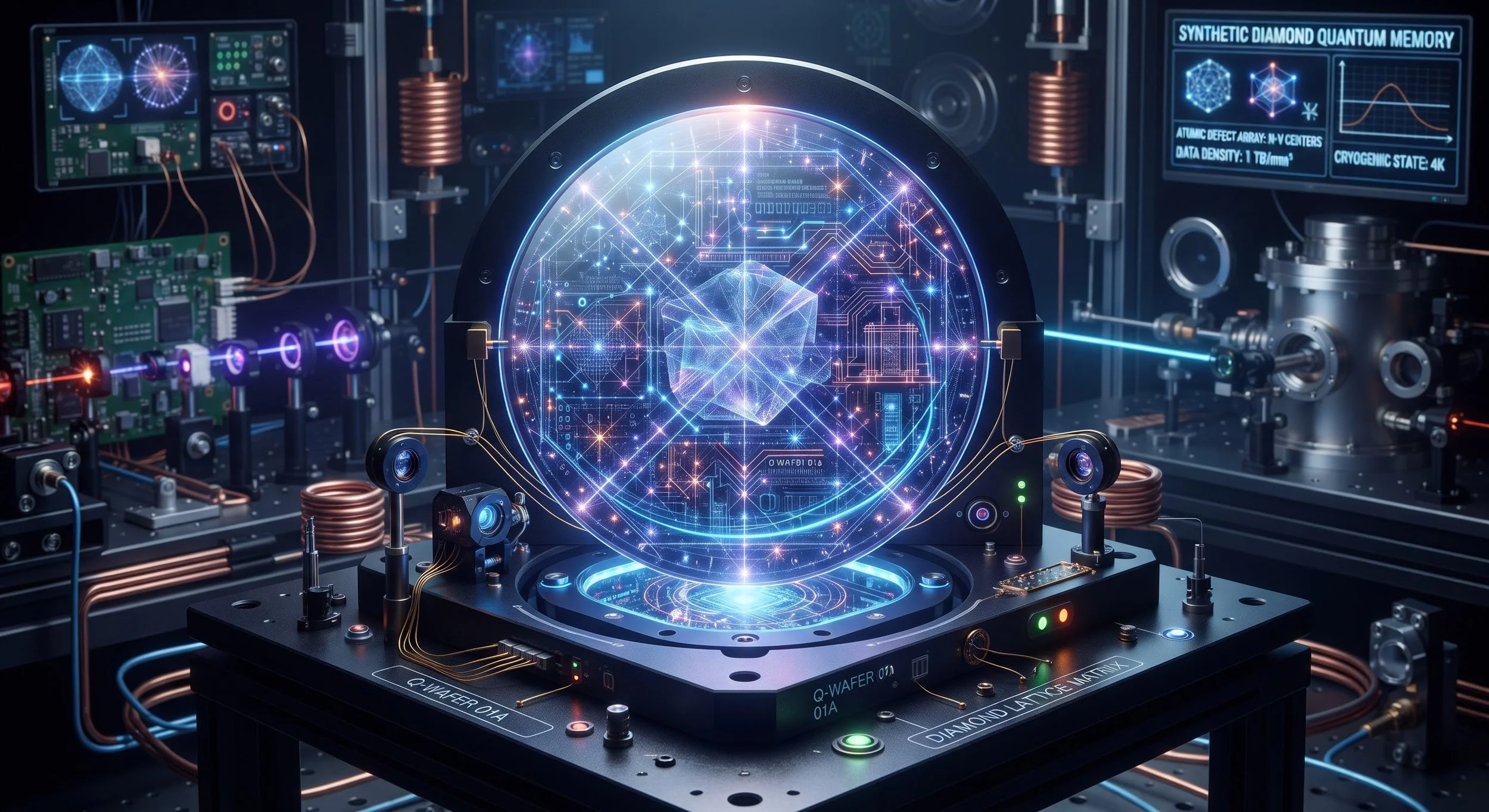
Traditional data storage is facing a ticking clock. Hard disk drives (HDDs) degrade, solid-state drives (SSDs) suffer from electrical charge leakage, and magnetic tapes decay over decades. For humanity's most critical archives, scientific data, and historical records, we need a medium that can outlast civilizations.
Enter the future of digital preservation: synthetic diamonds.
Recent breakthroughs have transformed lab-grown diamonds from industrial cutting tools and jewelry into ultra-dense, nearly indestructible data vaults capable of surviving for millions—or even trillions—of years.
Why Synthetic Diamonds?
Diamonds are the hardest natural material known to science, possessing extreme thermal conductivity and chemical inertness. They laugh off extreme heat, magnetic fields, corrosive acids, and physical wear and tear.
However, storing data inside a diamond isn’t about carving zeroes and ones onto the surface. Instead, scientists utilize atomic-scale imperfections within the diamond crystal lattice known as Frenkel defects (specifically, General Radiation 1 or GR1 centers).
By using ultra-short femtosecond laser pulses (pulses lasting just quadrillionths of a second), researchers can target specific points inside a synthetic diamond wafer to create precise, microscopic structural alterations. These tiny structural defects act as individual memory units.
Because of a diamond's rigid carbon matrix, these memory points are locked in place. Laboratory models suggest that data encoded this way can remain stable at room temperature for an astounding 10^{14} years with over 99% accuracy.
How is Information Written and Retrieved?
Writing data into a diamond is an exercise in nanoscale precision, but reading it back requires an equally sophisticated optical process. Here is how the information retrieval cycle works:
1. The Multi-Dimensional Encoding (Writing)
Before you can retrieve data, it has to be packed efficiently. Scientists use a four-dimensional optical storage method that combines:
3D Positioning: Placing defects across precise coordinate layers deep inside the diamond wafer.
Fluorescence Intensity Levels: Varying the intensity levels of light emitted by the defects to encode multiple bits of data per site.
This system achieves staggering data densities—reaching upwards of 14.8 terabits per cubic centimeter in cutting-edge tests. To put that in perspective, complex files like high-resolution color images and full motion videos (such as historical film clips) have been successfully written and recovered with near-perfect fidelity.
2. Laser Stimulation and Confocal Microscopy (Retrieval)
When it’s time to read the data back, the retrieval system doesn’t rely on physical contact or magnetic read-heads. Instead, it uses optical reading mechanisms:
Fluorescence Activation: The diamond is scanned using specific wavelengths of light. The GR1 defect centers act as fluorescent defects that exhibit ultra-high fluorescence stability and resistance to photobleaching.
Parallel Reading Channels: Advanced configurations use confocal microscopy setups to read thousands of storage channels simultaneously.
Decoding the 4D Matrix: The reader measures the precise 3D coordinates of the defects coupled with their varying fluorescence intensity levels, translating those optical signals back into standard digital files (binary data).
Because the reading process relies on light and non-destructive optical scanning, the data can be read repeatedly without degrading the physical medium—meaning you can access the same file billions of times and the diamond will remain entirely unaffected.
The Ultimate Digital Time Capsule
While you won't be swapping your laptop's SSD for a diamond wafer anytime soon, synthetic diamond storage is a game-changer for cold storage and archival preservation.
Governments, space agencies, global libraries, and scientific institutions face the daunting task of future-proofing human knowledge. With synthetic diamond technology, we are moving toward a reality where humanity’s most vital blueprints, art, and histories can be etched into crystal—waiting quietly to be illuminated, read, and understood by whatever—or whoever—comes next.